What Nobody Has Told You About Dental Implants in Tijuana
What Is a Dental Implant? The Basic Definition Every Website Gives You
Let’s start with the standard definition, the one you have probably seen on countless websites. A dental implant is an artificial tooth root placed into the jawbone to replace a missing tooth. After it integrates with the bone, it supports a crown. That definition is correct. It is also only the beginning.
Because when most websites explain what a dental implant is, they usually stop at the simplest part. What they do not explain clearly is that long-term success depends on much more than placing an implant. It depends on planning, materials, brand selection, healing, and the quality of the final crown.
Dental Implants Are Not Just About Replacing a Missing Tooth
If you lost a tooth, a dental implant can be one of the best ways to restore function, stability, and appearance. But an implant should never be understood as just a screw placed into bone. It is part of a full treatment process.
A complete implant case usually involves:
Diagnosis and bone evaluation
Implant system selection
Precise surgical placement
Healing and osseointegration
Restorative connection components
The final crown
That means the real value of implant treatment is not just surgery. It is how every step works together.
Not All Dental Implant Brands Are the Same
This is one of the most important things patients in California should know before comparing treatment options in the U.S. and Mexico. From the outside, many implants may look similar. In reality, they are not.
Different implant systems vary in connection design, surface technology, restorative compatibility, scientific support, and long-term maintenance options.
Some of the best-known implant brands in global dentistry include:
Straumann — Switzerland, founded in 1954.
Nobel Biocare — Swedish origin, founded as Nobelpharma in 1981 in Gothenburg, Sweden.
Astra Tech Implant System — Sweden; its clinical development dates back decades, with documented clinical use beginning in the 1980s.
ZimVie / legacy 3i-Biomet — United States; ZimVie became an independent company in 2022, while its Biomet legacy dates to 1977.
BioHorizons — United States, founded in 1994 from research at the University of Alabama at Birmingham.
Osstem — South Korea, founded in 1997.
Neodent — Brazil, founded in 1993 in Curitiba.
MIS Implants — Israel, founded in 1995.
Camlog — Germany, with the CAMLOG system launched in 1999 and strong German/Swiss manufacturing history.
MegaGen — South Korea, founded in 2002.
Dental implant brands should not be judged by price alone, but by their track record. In implant dentistry, time is not a minor detail; it is one of the most meaningful forms of validation. Over the years, an implant system proves whether it can truly deliver stability, precision, restorative compatibility, and consistent outcomes. Longevity in the market, clinical follow-up, and scientific documentation do not simply support a brand; they test it.
For that reason, when a clinician chooses to work with certain implant brands, the decision is rarely arbitrary. Nor does it mean that one brand is suitable for every case. In practice, many specialists prefer to work with multiple systems because each patient presents different anatomical conditions, restorative demands, and treatment objectives. Even within the same brand, there are different implant lines, diameters, lengths, and designs intended for specific clinical situations. That variety is not merely commercial; it reflects the need for more precise selection based on the patient’s actual needs.
This is a point that is rarely explained with enough clarity: it is not wise to receive an implant system that has little history, limited follow-up, or insufficient scientific validation simply because it is less expensive. Many newer brands enter the market at lower prices precisely because they have not yet demonstrated, over time, that their performance is reliable. In implant dentistry, price alone is not a measure of quality. What truly matters is the level of clinical, technical, and scientific support behind the system being used.
Titanium vs Zirconia Dental Implants: What Patients Should Know
This is another topic that often gets oversimplified.
Titanium Dental Implants
Titanium remains the most widely used material in implant dentistry because of its long clinical history, strong biocompatibility, and predictable performance. For many dentists and oral surgeons, it remains the most established option.
Zirconia Dental Implants
Zirconia implants are a metal-free alternative and may be appealing in selected cases, especially when patients are focused on certain esthetic or material preferences. But the key point is this: a different material is not automatically a better one. The right choice depends on the case, the bone, the smile line, and the overall restorative plan.
The Final Dental Crown Matters as Much as the Dental Implant
Patients often focus on the implant itself and forget about the part they will actually see and use every day: the crown.
The final dental crown affects:
Appearance
Bite
Comfort while eating
Cleanability
Smile harmony
Long-term function
That is why a well-made zirconia crown can completely change the final result. A good implant with a poorly designed restoration is still a compromised treatment. True quality means both the implant and the final restoration have to work together.
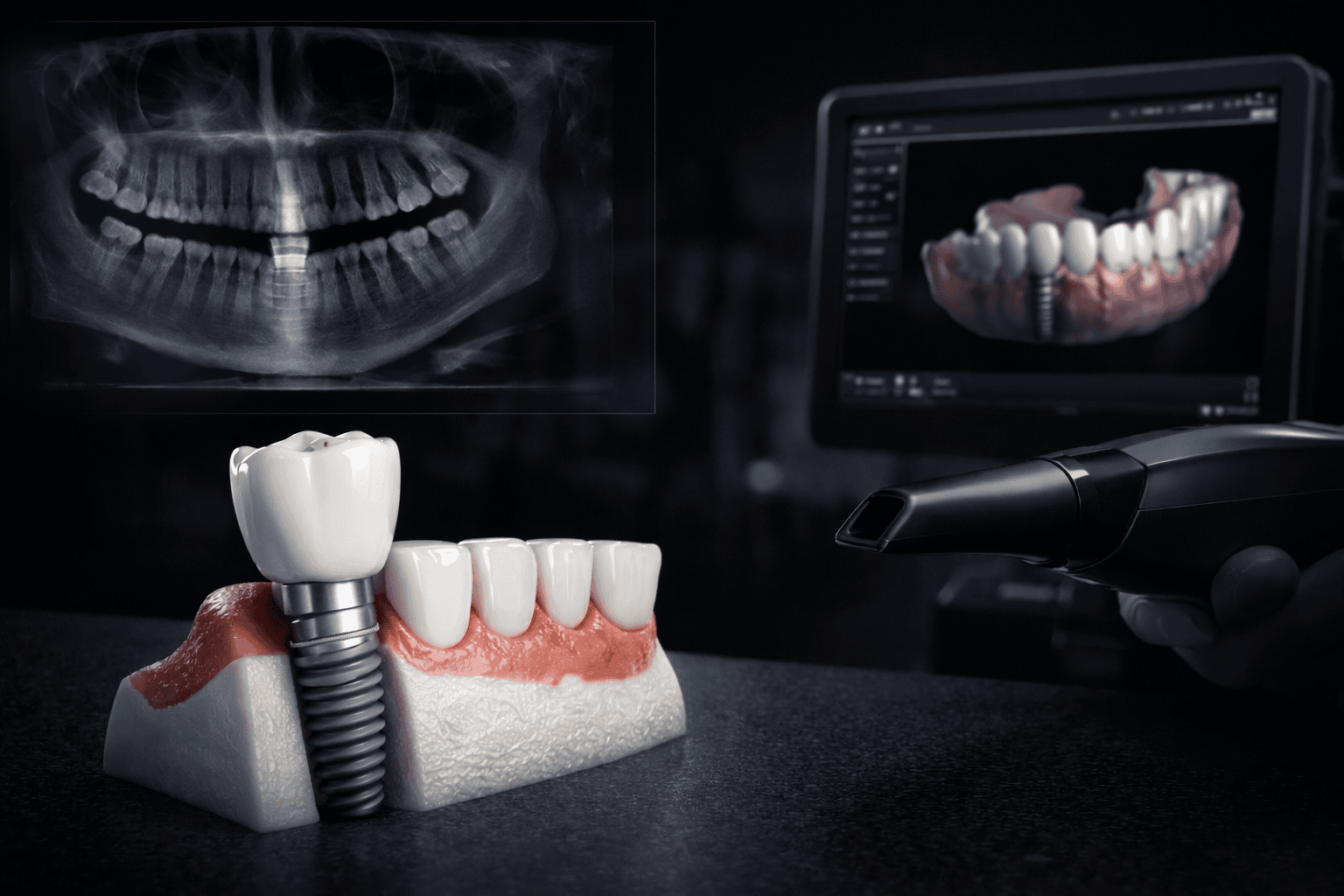
Digital Dental Implants in Tijuana: CT Scan, Intraoral Scan, and Guided Surgery
Modern implant dentistry should not rely on guesswork. A digital workflow helps the team plan treatment more precisely from the beginning.
Here is what that usually includes:
CT scan / CBCT: a 3D scan that shows bone volume, bone width, bone height, and key anatomical structures like nerves and sinuses. It provides much more information than a basic 2D X-ray.
Intraoral scan: a digital scan of the teeth and gums that replaces many traditional impressions and helps design restorations more accurately.
Digital treatment planning: combines the CBCT and intraoral scan to determine ideal implant positioning.
Surgical guide: a custom guide made from the digital plan to improve precision during implant placement.
Final restoration design: helps the team plan not just the surgery, but the crown that will complete the case.
This is one of the reasons many California patients are now looking at advanced dental clinics in Tijuana more seriously. Digital planning helps create more predictable, more restorative-driven treatment.
Same-Day Dental Implants: What That Really Means
“Same-day dental implants” sounds simple. In reality, it needs context.
Yes, in some cases an implant can be placed the same day a tooth is removed. Yes, in selected cases a temporary tooth can also be placed quickly. But that does not mean the implant is already fully healed.
After surgery, the implant still needs osseointegration, the biological process where bone bonds to the implant. That healing phase is still critical. Faster protocols may be possible in selected cases, but healing time remains one of the most important factors in long-term implant success.
Why More California Patients Are Looking at Dental Implants in Tijuana
For many years, people in California assumed that going to Tijuana only meant lower prices. That is no longer the full picture.
Today, Tijuana is home to clinics using digital workflows, guided surgery, high-quality restorative materials, and modern implant protocols. For patients coming from San Diego, Orange County, Los Angeles, or the Inland Empire, Tijuana also offers proximity and convenience.
At EnamelDent, we believe patients should understand that choosing Tijuana does not have to mean compromising on quality. In the right clinic, it can mean access to advanced planning, high-level restorative work, and a team that treats implants as a full restorative process, not just a quick surgical procedure.
Learn More About Dental Implants in Tijuana at Enameldent
If you want to learn more about dental implants, implant brands, healing times, zirconia crowns, and digital implant planning, Enamel Dent is here to help.
We are a clinic focused on dental implants in Tijuana, with a modern digital workflow and a restorative-driven approach designed for patients who want quality, clarity, and a treatment plan they can understand.