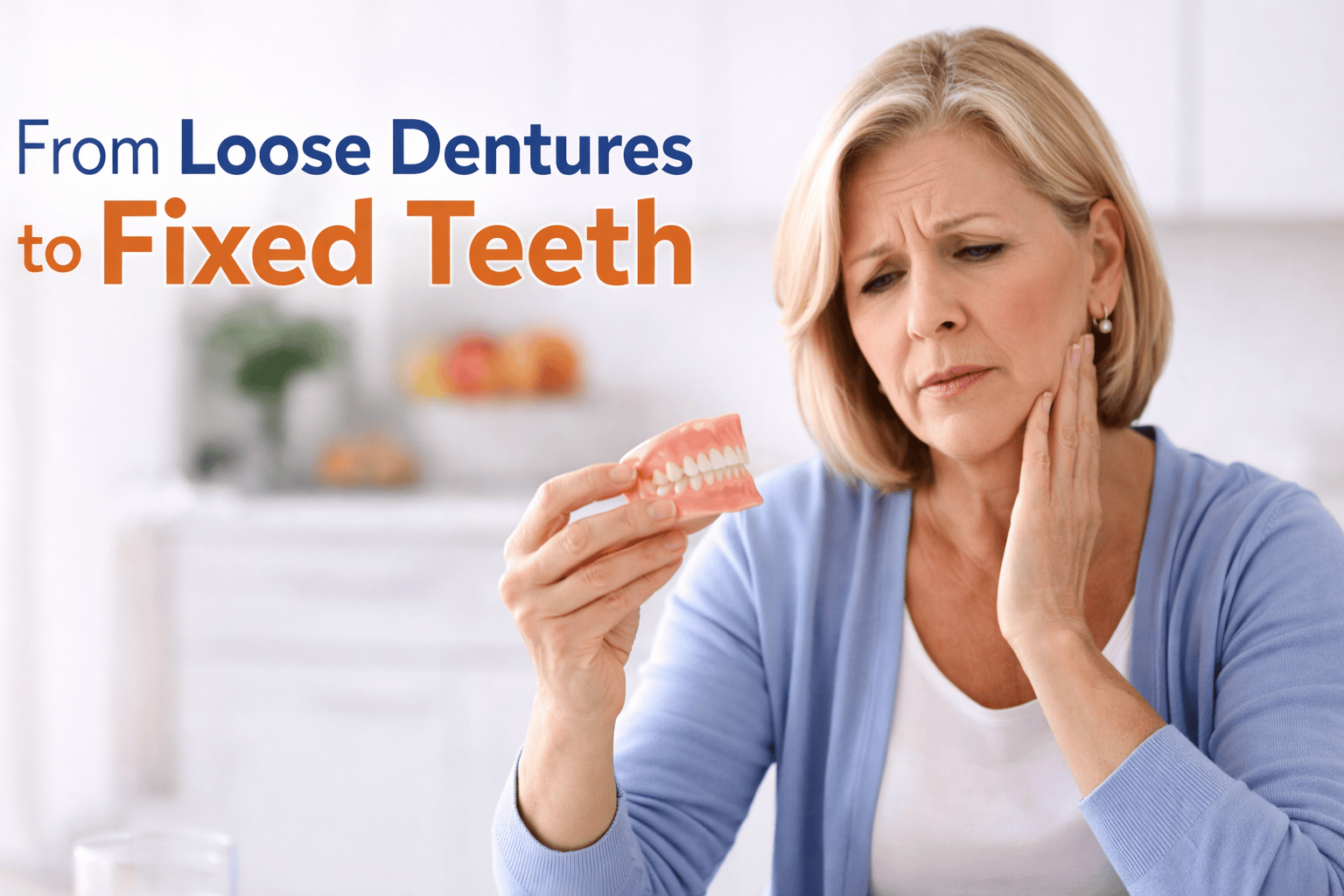
Why So Many People Start Hating Their Dentures
At first, removable dentures can feel like the answer. After losing teeth, having something that restores your smile may seem like a relief. But with time, many patients begin to realize that the experience is not as comfortable or as natural as they hoped. The most common complaint is simple and deeply frustrating: dentures move when eating. That one problem alone can affect everything. You stop enjoying meals, become careful with every bite, and start avoiding foods you used to love. It is often in these small daily moments that people begin thinking, I hate my dentures, what are my options? That thought usually does not come from vanity. It comes from exhaustion, disappointment, and the feeling that life should not revolve around managing your teeth.
The challenge is that dentures are often presented as the final step, when for many people they are only a temporary phase. As the months or years pass, patients start searching for loose dentures solutions, hoping that a better adhesive, a reline, or a minor adjustment will finally make things feel secure. Sometimes those things help for a while, but they rarely create the kind of confidence people truly want. The denture may still slip when talking, rub against the gums, or feel bulky and unstable. That is when the search becomes more serious. Instead of asking how to make dentures tolerable, patients begin exploring alternatives to dentures and wondering whether there is a more stable path forward.
What makes this even harder is that dentures can affect much more than chewing. They influence social confidence, speech, comfort, and even identity. A person may smile less, avoid restaurants, or feel anxious during conversations because they never fully trust what is happening in their mouth. This is why so many people eventually feel ready to invest in the next level. They are not simply buying a dental procedure. They are trying to regain comfort, freedom, and control. And that is exactly where the conversation shifts from removable dentures to fixed solutions.
The Real Problem Behind Loose Dentures
One of the biggest reasons dentures become more frustrating over time is that the mouth itself keeps changing. After teeth are lost, the jawbone naturally begins to shrink because it no longer receives stimulation from tooth roots. That means the surface supporting the denture gradually changes shape, and the appliance that once seemed to fit reasonably well can start feeling unstable. This is why people often search for denture problems and solutions or ask about the best dentures for bone loss. The truth is that even a well made denture can become less effective if the bone underneath keeps shrinking. The issue is not always that the denture was poorly made. Often, the real problem is the loss of support beneath it.
This is also why traditional dentures can become more difficult to wear as time goes on. A patient may think, Why do my dentures keep getting worse if I already paid to fix this? The answer is that removable dentures sit on the gums, but they do not replace the roots that once helped preserve bone. As a result, many people with long term denture use experience a cycle of looseness, discomfort, and repeated adjustments. They search for options if I cannot wear dentures because the problem stops being occasional and becomes part of everyday life. Once eating, speaking, and smiling all start to feel compromised, the need for a more stable answer becomes much more urgent.
For patients with advanced bone loss, the fear is often that it is too late. They may assume they no longer qualify for anything better. But the presence of bone loss does not automatically mean removable dentures are the only option. In many cases, people who are searching for fixed teeth with bone loss are surprised to learn that modern implant dentistry may still offer solutions. The first step is understanding that loose dentures are not always the final reality. They are often a sign that the current solution is no longer enough.
What Are the Best Alternatives to Dentures
When people begin looking beyond removable teeth, one of the most important questions becomes which type of replacement actually fits their needs. Many patients comparing snap on dentures vs implants are trying to understand whether they want a removable solution with more support or a true fixed option. Snap on dentures can be a major improvement over traditional dentures because implants help hold them in place, reducing movement and improving confidence. For some people, that extra stability is exactly what they need. But for others, the fact that the teeth still come out means the experience still does not feel complete. They do not just want a better denture. They want to stop having dentures altogether.
This is where the idea of fixed teeth instead of dentures becomes so appealing. Fixed teeth are attached to implants and designed to stay in place, which changes how patients experience daily life. Instead of depending on adhesives or worrying whether the denture will shift, patients can feel a more solid connection when chewing and speaking. For those who have spent years adapting their habits around removable teeth, this can feel like a completely different category of treatment. It is no longer about managing a denture. It is about replacing lost teeth in a way that feels stronger, more secure, and more natural.
Patients who have lost most or all of their teeth often search for full mouth tooth replacement options because they want a clear comparison, not confusing technical language. They want to know what is realistic, what feels most stable, and what gives them the best long term value. In many cases, the answer involves implant based treatment, whether that means a snap on option for more retention or a fixed full arch solution for maximum stability. The key difference is not only how the teeth are held in place, but how they make the patient feel every day. That emotional and functional difference is what drives so many people to move beyond removable dentures.
How Implants Change the Conversation
Dental implants change the conversation because they address a problem dentures do not solve. Instead of resting on the gums, implants are placed into the jawbone and function like artificial roots. This creates a stronger foundation for replacement teeth and can dramatically improve stability. That is why people searching for implants for loose dentures are often not just looking for another adjustment. They are looking for a different experience. They want to eat confidently, laugh freely, and stop planning their day around whether their teeth will cooperate. Implants make that kind of stability possible in a way traditional dentures simply cannot.
For patients missing an entire upper or lower arch, implant supported full arch treatment has become one of the most important advances in modern dentistry. This is why terms like how to replace all teeth permanently, full mouth dental implants near me, and new teeth after losing all teeth are searched so often. People want to know whether there is a real path from removable teeth to something fixed and reliable. In many cases, there is. Full arch solutions use a strategic number of implants to support an entire set of teeth, giving patients the possibility of a much more secure and functional smile. For someone who has spent years feeling limited by dentures, this can be life changing.
This type of treatment is also increasingly relevant for older adults. Searches for permanent teeth replacement for seniors reflect a growing awareness that age alone does not mean a person has to settle for removable dentures forever. Many seniors are active, social, and unwilling to accept a smile that feels unstable or incomplete. They want a solution that allows them to enjoy meals, speak clearly, and feel like themselves again. In that sense, implants are not just about replacing teeth. They are about restoring confidence and quality of life.
Why So Many Patients Look to Mexico for Full Mouth Implants
Once patients begin understanding the benefits of fixed teeth, the next question is usually cost. This is one of the biggest reasons people search for affordable dental implants Mexico, all on 4 cost Mexico, and dental implants cost Tijuana. In the United States, full mouth implant treatment can be financially overwhelming, even for people who know it is the right solution. That price difference pushes many patients to explore options in Mexico, especially in border cities where advanced care can be more accessible. The goal is not simply to find the cheapest treatment. It is to find high value care that makes a true upgrade realistic.
Tijuana has become a major point of interest because many patients can access care there more easily while still seeking advanced dental solutions. Searches for dental implants cost Tijuana often come from people who are already convinced they want fixed teeth, but need a path that fits their budget. They are comparing value, not just price. They want to know whether they can receive professional treatment, modern technology, and predictable results without facing the financial pressure they would experience elsewhere. That is why Mexico has become such a common destination for patients who want to move from removable dentures to a more permanent option.
At the same time, cost should always be understood in context. The cheapest temporary fix is not always the best financial decision if it leads to ongoing discomfort, repeated adjustments, and years of frustration. Many patients eventually realize that investing in a more stable full arch solution can make more sense than continuing to spend money on a system that never truly feels right. That is why questions about all on 4 cost Mexico are often really questions about value, comfort, and long term quality of life.
When It Is Time to Move to the Next Level
There usually comes a point when the issue is no longer whether removable dentures can be improved. The real question becomes whether they should still be your long term plan at all. If your dentures move when eating, if you are constantly searching for loose dentures solutions, or if you keep wondering about alternatives to dentures, those thoughts are not random. They are signs that your current solution may no longer match your needs. Many patients live with this frustration for years because they assume it is normal. But normal does not always mean acceptable, and familiar does not always mean best.
The next level is not just about having more expensive dentistry. It is about choosing a solution that better supports your life. For some patients, that may mean snap on dentures supported by implants. For others, it means truly fixed teeth instead of dentures. The right answer depends on bone, health, expectations, and budget, but the important thing is recognizing that better options do exist. If you have been asking I hate my dentures what are my options, that question already contains the beginning of the answer. You are looking for something more secure, more comfortable, and more permanent than what you have now.
In the end, the search for the best option for missing all teeth is really the search for stability, dignity, and peace of mind. It is about finding a solution that lets you eat without worry, smile without hesitation, and stop thinking about your teeth every hour of the day. Whether you are exploring full mouth tooth replacement options, comparing snap on dentures vs implants, or researching options if I cannot wear dentures, the message is the same. You do not have to stay stuck with a solution that feels like a compromise. For many patients, the next level is not a luxury. It is the first time their tooth replacement truly feels like it fits their life.