When You Start Looking for New Teeth, Everything Can Sound the Same
If you have been researching full-mouth tooth replacement options, you have probably noticed how quickly everything starts to sound alike. One website talks about All on 4 dental implants. Another mentions Snap On dental implants. Then you come across All on 5, All on 6, and 3 on 6 dental implants, and before long it can feel difficult to tell where one treatment ends and another begins.
That confusion is completely normal.
Most people do not begin this process knowing dental terminology. They begin because something in daily life is no longer working. Maybe your dentures feel loose. Maybe chewing has become frustrating. Maybe you are tired of taking dentures in and out. Maybe you are simply trying to understand the best option for missing all teeth without feeling overwhelmed by technical language.
The good news is that these treatments are not meant to confuse you. They exist because different patients have different needs. Some people wantfixed teeth instead of dentures.Others want removable dentures with more stability. Some are dealing with advanced bone loss. Others mainly want to stop the movement and insecurity that come with traditional dentures.
The key is not choosing the most famous name. The key is understanding what each option is really designed to do.
When You Start Looking for New Teeth, Everything Can Sound the Same
There is a reason so many patients ask about All on 4 dental implants first. It is one of the most recognized names in implant dentistry, so it often becomes the starting point for people looking for a long-term solution after major tooth loss.
For many patients, All on 4 sounds like the answer to a very simple hope: having teeth that stay in place and feel more dependable in daily life.
That is why the treatment gets so much attention. But while the name is familiar, the details are not always clear. Some patients assume that Snap On dental implants, All on 4, All on 5, All on 6, and 3 on 6 are all basically the same treatment with different pricing or branding. In reality, they are different treatment concepts. Some are removable. Some are fixed. Some are often helpful in cases with bone loss. Others may be recommended when there is better bone availability and a wider support base is possible.
So yes, All on 4 is important. But it is only one part of the bigger conversation about full-mouth dental implant options.
Traditional Dentures: Why So Many Patients Start Looking for Alternatives
- dentures move when eatingentures move when eatingentures move when eating
- loose dentures solutions
- I hate my dentures
- options if I cannot wear dentures
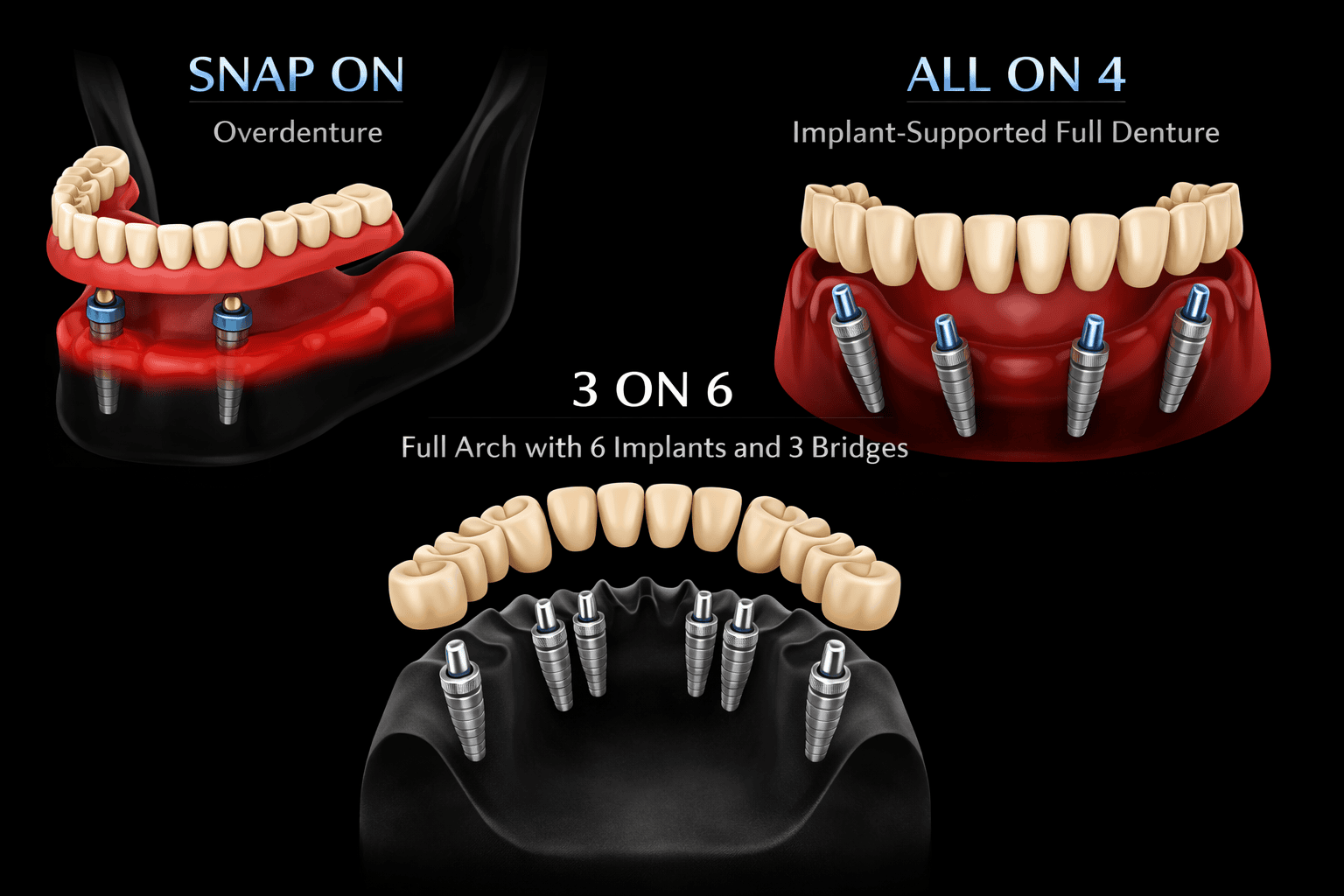
Snap On Dental Implants: A More Secure Removable Option
For patients who want a major improvement in stability without moving directly into fixed teeth, Snap On dental implants can be a very helpful option.
This treatment is often a good fit for people searching for implants for loose dentures or hoping to find removable dentures with more stability. A Snap On denture is still removable, but instead of resting only on the gums, it connects to implants placed in the jaw. That added support can make a very meaningful difference in everyday life.
Many patients feel more confident speaking. Eating usually feels easier. The denture may move much less, and reliance on adhesives can often be reduced. For someone who has spent years trying to manage a denture that shifts at the wrong moment, that added security can feel like real relief.
At the same time, it is important to keep expectations clear. Snap On dentures are removable implant-supported dentures. They are not fixed teeth. They still come out for cleaning. They do not offer the exact same experience as a restoration that remains in place all the time.
That does not make them a lesser option. It just means they solve a different problem. For the right patient, Snap On can be a very satisfying middle ground between traditional dentures and fixed full-arch restorations.
Not Every Snap On Denture Feels the Same
Even within the Snap On category, there can be important differences.
Some Snap On dentures are supported by two implants. Others may use three or four. That can affect retention, support, comfort, and how stable the denture feels throughout the day.
For some patients, two implants may already provide a major improvement over a conventional denture. For others, a design with more support may feel more secure and function better. This can be especially relevant for patients looking into better denture options for patients with bone loss or researching permanent teeth replacement for seniors and trying to understand what kind of result may be realistic for them.
The important point is that treatment should not be chosen like a number competition. More implants do not automatically mean better for every person. The goal is to find the level of support that makes the most sense for the patient’s anatomy, goals, and daily needs.
All on 4 Dental Implants: Fixed Teeth for Patients Who Want More Stability
If Snap On helps stabilize a removable denture, All on 4 dental implants belong to a different category. This is a fixed full-arch treatment designed for patients who want teeth that stay in place rather than a prosthesis they remove every day.
That is one reason so many people are drawn to it.
For patients who are tired of loose dentures, tired of adhesives, or tired of planning meals around what feels safe to chew, All on 4 can sound life-changing. And for many people, it truly can be.
Another reason this treatment gets so much attention is that it is often discussed in relation to bone loss. By placing the back implants at an angle, it is often possible to make efficient use of the available bone. That is why All on 4 is frequently part of the conversation for patients researching fixed teeth with bone loss or dental implants for severe bone loss.
This does not mean All on 4 is automatically the right option for everyone. It simply means the treatment was designed with a very practical purpose. It can help many patients move toward fixed teeth even when bone conditions are not ideal for other approaches.
So when people ask about All on 4, they are often not just asking about four implants. They are asking whether fixed teeth may finally be possible for them.
All on 5 and All on 6 Dental Implants: When More Support Makes Sense
After patients learn about All on 4, many naturally ask whether more implants are better. That is where All on 5 dental implants and All on 6 dental implants enter the conversation.
In some situations, having more implants can provide a broader support base and allow chewing forces to be distributed over a wider area. That may help create a stronger foundation, especially when the patient has the bone support and anatomy to allow it.
Still, this part should be explained with care. More implants do not automatically mean a better choice for every patient. The goal is not to chase the biggest number. The goal is to understand why a certain design makes sense for a certain person.
A patient with stronger bone support may benefit from All on 6 dental implants. Another may do very well with All on 5. Another may still be an excellent candidate for All on 4. Each option needs to be understood in context.
For patients trying to find the best option for replacing all missing teeth, that can actually be reassuring. The best answer is not always the most marketed one. It is the one that fits your anatomy, your goals, and the kind of daily experience you want to have.
3 on 6 Dental Implants: A Different Kind of Fixed Design
Another treatment some patients come across is 3 on 6 dental implants. This approach is different from a one-piece full-arch bridge because it uses six implants to support three separate bridges.
For some people, that sounds appealing because it feels closer to the idea of natural sections of teeth rather than one continuous prosthesis. In the right case, it can be an excellent option.
But like every other treatment discussed here, it should not be seen as automatically better just because it sounds different. 3 on 6 dental implants have their own logic, and they tend to require the right bone conditions, bite, and planning. They are another good example of why treatment names should not be chosen like products on a shelf. They need to be matched to the person.
Which Full-Mouth Tooth Replacement Option May Be Right for You?
This is usually the biggest question, and it is a fair one.
If your main goal is a removable option that feels much more secure than a traditional denture, Snap On dental implants may be worth serious consideration. If you want fixed teeth instead of dentures, and bone loss is part of the picture, All on 4 dental implants may make a lot of sense. If you have stronger bone support and your case would benefit from a broader base, All on 5 or All on 6 dental implants may be considered. If your anatomy is favorable for a segmented fixed design, 3 on 6 dental implants may also be an option.
And sometimes the starting point is even simpler than choosing a treatment name. Sometimes it begins with the realization that what you have now is no longer working. For people looking for new teeth after losing all teeth, or trying to understand options if I cannot wear dentures, the first real step is getting a clear diagnosis and learning what is actually possible in their case.
The Goal Is Not Pressure. The Goal Is Clarity
When someone has been struggling with tooth loss or uncomfortable dentures, the last thing they need is more confusion.
They do not need a treatment to be oversold. They do not need to feel pushed toward the most expensive option. They need a clear explanation from someone willing to slow things down and explain what each treatment really means.
The most helpful questions are often the simplest ones.
Is it removable or fixed? How stable will it feel? How is it cleaned? What role does bone loss play? What are the trade-offs? What seems most realistic for my needs?
Those are the kinds of questions that turn confusion into understanding.
Choosing Well Means Understanding Why Each Treatment Exists
Each of these treatments exists for a reason.
Traditional dentures remain one option, even if they can become harder to live with over time.
So if all these names have felt confusing, that is completely understandable. Most people do not begin this process knowing the difference.
The good news is that once the treatments are explained in a simple, honest, and human way, the decision becomes much easier to understand. And usually, that is what patients need most.
Not more pressure. Not more noise. Just clarity, good advice, and a solution that truly fits their life.